 An official website of the United States government




Healthy hearing allows us to communicate, appreciate the soundscapes in our environments, and attend to warning sounds.
Overview
Hearing health matters for people of all ages. Healthy hearing allows us to communicate with friends, families, and doctors, appreciate the soundscapes in our environments like crackling fires and twittering birds, and attend to doorbells, phone rings, and warning sounds.
Not all forms of hearing loss are preventable, but there are ways to protect your hearing and address hearing loss that is negatively impacting your life. Noise-induced hearing loss is preventable by adopting healthy hearing practices, including limiting exposure to loud sounds and using hearing protection.
Most forms of hearing loss are treatable. Devices are available for those who seek treatment for hearing loss.
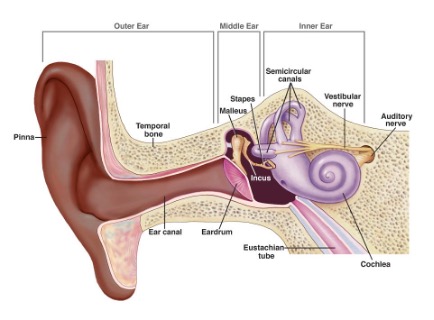
Source: NIH/National Institute on Deafness and Other Communication Disorders (NIDCD)
The Sense of Hearing
Hearing depends on a series of complex steps:
- Sound waves enter the outer ear and travel through a narrow passageway called the ear canal, which leads to the eardrum.
- The eardrum vibrates from the incoming sound waves and sends these vibrations to three tiny bones in the middle ear. These bones are called the malleus, incus, and stapes.
- The bones in the middle ear amplify, or increase, the sound vibrations and send them to the cochlea, a snail-shaped structure filled with fluid, in the inner ear. An elastic partition runs from the beginning to the end of the cochlea, splitting it into an upper and lower part. This partition is called the basilar membrane because it serves as the base, or ground floor, on which key hearing structures sit.
- Once the vibrations cause the fluid inside the cochlea to ripple, a traveling wave forms along the basilar membrane. Hair cells—sensory cells sitting on top of the basilar membrane—move as the wave travels through the cochlea. Hair cells near the narrow, stiff end of the cochlear detect higher-pitched sounds, such as leaves rustling or a flute. Those along the wider, flexible end are tuned to lower-frequency sounds, like some machinery or a tuba.
- As the hair cells move up and down, microscopic hair-like projections (known as stereocilia) that perch on top of the hair cells bump against an overlying structure and bend. This bending causes pore-like channels, which are at the tips of the stereocilia, to open up. When that happens, chemicals rush into the cells, creating an electrical signal.
- The auditory nerve carries this electrical signal to the brain, which turns it into a sound that we recognize and understand.
This animated video illustrates how sounds travel from the ear to the brain, where they are interpreted and understood.Prevention Guidance
You can take steps to reduce noise-induced hearing loss.
Just as wearing sunscreen can protect against sun damage, healthy hearing habits can protect you from noise-induced hearing loss. The three key habits are:
- Lower the volume. Set devices — such as music players and televisions — to low volumes.
- Move away from the noise. The closer you are to the source of the sound, the louder it will be.
- Wear hearing protection. Use earplugs or earmuffs when you cannot lower the volume or move away from the sound.
Developing healthy hearing habits while young is a key step to preventing hearing loss.
To measure sound risks in your environment, you can use the Sound Level Meter app, a free app developed for iOS devices by the CDC’s National Institute for Occupational Safety and Health (NIOSH).
Hearing protectors
Hearing protectors are wearable devices that lower the intensity of sound entering your ears. Make it a habit to wear hearing protectors when you expect to be in a loud setting and keep earplugs or earmuffs handy for unexpected loud noises. If loud noise happens suddenly, cover your ears with your hands and move away from the noise if possible
Hearing protectors do not block all sound. Most hearing protectors have a noise reduction rating (NRR) — in general, the higher the NRR, the more sound is blocked when the device is worn correctly. A higher NRR is not always better, however; if the NRR is too high or the protectors are not a good match for your specific environment or activity, you are more likely to remove your hearing protectors to communicate.
Choose hearing protectors that allow you to communicate well in a noisy environment, so that you do not have to remove them during conversation. Even briefly removing your hearing protectors in a very loud environment puts your hearing at risk.
Consult a hearing health professional if you need help selecting hearing protection, or for information about custom-made earplugs.
There are different types of hearing protectors.
Earplugs
Earplugs are inexpensive devices placed directly into your ear canal. They come in various sizes, though some may be too large for children. Earplugs may have cords attached to help you keep track of them.
Formable foam earplugs are made of soft foam. Once inserted, they expand to fill the ear canal snugly. They are meant for one-time use but can be reused if they are clean and still fully expand to their original shape.
This video demonstrates the correct way to use formable earplugs to help prevent noise-induced hearing loss.
How to use formable foam earplugs:
- Gently roll the earplug between your fingers into a thin tube shape, taking care not to crease the foam, which can create tunnels for sound to enter.
- Pull the top of your ear up and back with your opposite hand to straighten your ear canal.
- Continue to roll the earplug and gently slide it into your ear canal. It should fit evenly across the opening of your ear.
- Gently hold the earplug in place with your finger for 20–30 seconds to give it time to expand.
- Check the fit to make sure the earplug is comfortable and properly inserted. The earplug should barely be visible when positioned correctly.
- Repeat steps to insert the earplug into your other ear.
- Do not cut or tear foam earplugs to make them fit — cutting the foam reduces its effectiveness.
- To remove, slowly twist to break the seal with your ear canal, then gently take them out.
Pre-molded earplugs are made from plastic, rubber, or silicone and are sold in different sizes, including sizes that fit children. One type — high-fidelity (hi-fi) or uniform-attenuation earplugs — evenly decreases sound intensity across different pitches, similar to turning down the volume on a stereo. These may be especially helpful at movies or concerts where you want to appreciate audio quality while protecting your hearing.
How to use pre-molded earplugs:
- Gently pull the top of your ear up and back with your opposite hand to straighten your ear canal.
- Use the other hand to firmly grip the stem of the earplug and gently slide it into the ear canal using a rocking motion until you have sealed the ear canal.
- To remove, slowly rock them back and forth to break the seal, then gently pull them out.
This video demonstrates the correct way to use pre-molded earplugs to help prevent noise-induced hearing loss.
Canal Caps have a stiff band that provides a gentle force to seal the earplugs into your ear canal. When not in use, the band can be worn around your neck.
Earmuff Hearing Protectors
Protective earmuffs are easy-to-use, padded plastic and foam cups joined by an adjustable headband. They reduce noise by completely covering both ears. Sizes for adults and children — including infants — are available. Earmuffs are easier than earplugs to use correctly, especially for young children.
Earmuffs may not work as well for people who wear glasses, because the arms of the glasses can create gaps between the earmuff cushion and the skull. Hairstyles, hats, and facial hair can also create gaps that reduce effectiveness.
How to use protective earmuffs:
- Grasp one cup in each hand and gently pull apart.
- Place the band over the top of your head and slowly release the cups, making sure they completely cover the ears and fit snugly.
Wearing earmuffs and earplugs together can further reduce sound, which is helpful in very noisy environments like woodshops and shooting sports events.
Preventing Hearing Loss in Children
Just as you teach children to wear sunscreen, a seatbelt, and a bicycle helmet, you can teach them about healthy hearing habits. Here are strategies:
- Set clear rules for when to wear hearing protectors. Tell your children you expect them to wear hearing protectors in noisy areas, even when you are not there to supervise.
- Shop for hearing protectors with them. Discuss whether they would rather wear earplugs that can be hidden by hair or a hat, or make a fashion statement with more noticeable hearing protectors. Many colorful and comfortable styles are available in stores and online.
- Choose hearing protectors that fit with your children’s activities. Make sure the size and type of hearing protectors work for the environment where they will be used. If the hearing protector blocks too much sound, your child might not be able to hear important warning sounds or might remove the protectors, risking hearing damage.
- Make sure hearing protection is within reach. Keep hearing protectors in household areas where loud noises are common, but out of reach of small children and pets.
- Be a good role model. Children learn through observation and imitation. If you adopt healthy hearing habits, your kids may do the same.
- Teach your child to keep the volume at a safe level when watching TV or listening to music.
- Help safeguard their environment by not buying noisy toys.
- When buying electronic devices, choose ones that let you set healthy volume limits.
Research shows that parents and other adults are important role models for children’s hearing health. You can take advantage of teachable moments — for example, when a child appreciates a subtle sound like a bird chirping, remind them how easy it is to damage hearing and lose the ability to hear those sounds.
Identifying and Living With Hearing Loss
Some people living with noise-induced hearing loss or age-related hearing loss might not know they have it, especially if it has slowly developed. If you or a loved one shows signs of hearing problems, talk with your doctor, an otolaryngologist (an ear, nose, and throat doctor), an audiologist, or a hearing instrument specialist.
If you do have some existing hearing loss, help is available if you choose to seek it. Treatment depends on the cause and severity of your hearing loss. Some treatments and devices will work better for you than others. Options include the following.
Hearing Aids
Hearing aids are small electronic devices you wear in or behind your ear. They make sounds louder so that a person with hearing loss can listen, communicate, and participate more fully in daily activities. A hearing aid has three basic parts: a microphone, amplifier, and speaker.
A hearing aid will not restore your normal hearing. With practice, however, a hearing aid will increase your awareness of sounds and their sources.
There are three basic styles of hearing aids:
- Behind-the-ear aids consist of a hard plastic case worn behind the ear, connected to a plastic earmold that fits inside the outer ear. These aids are used by people of all ages for mild to profound hearing loss.
- In-the-ear aids fit completely inside the outer ear and are used for mild to severe hearing loss.
- Canal aids fit into the ear canal and are available in two styles — in-the-canal and completely-in-canal. Both are used for mild to moderately severe hearing loss.
If you have hearing loss in both ears, two hearing aids are generally recommended because two aids provide a more natural signal to the brain.
Implantable hearing aids are also available. A middle ear implant (MEI) is a small device attached to one of the bones of the middle ear that moves those bones directly rather than amplifying sound traveling to the eardrum. A bone-anchored hearing aid (BAHA) attaches to the bone behind the ear and transmits sound vibrations directly to the inner ear through the skull, bypassing the middle ear. Because surgery is required to implant either of these devices, many hearing specialists feel that the benefits may not outweigh the risks.
Hearing aids are sometimes not covered by health insurance companies. Medicare does not cover hearing aids for adults; however, diagnostic evaluations are covered if ordered by a physician for the purpose of developing a treatment plan. Some Medicare supplemental plans provide hearing aid benefitsFor eligible children and young adults ages 21 and under, Medicaid may pay for the diagnosis and treatment of hearing loss, including hearing aids, under the Early and Periodic Screening, Diagnostic, and Treatment (EPSDT) service.
Some nonprofit organizations provide financial assistance for hearing aids, while others may help provide used or refurbished aids.
For perceived mild to moderate hearing loss, a new category of hearing aids for adults was established in 2022 by the U.S. Food and Drug Administration (FDA). These devices may be purchased over the counter from retail or online outlets without seeing a healthcare professional or getting a hearing test.
The FDA finalized the rule in August 2022, allowing hearing aids within this category to be sold directly to consumers in stores or online without a medical exam or a fitting by an audiologist. Hearing aids for more severe hearing loss or for users younger than age 18 remain prescription devices.
If you have tried an OTC hearing aid without success or have trouble hearing loud sounds, consult a hearing health professional, because your hearing loss may be more severe than you realize.
Cochlear Implants
Cochlear implants are small electronic devices that are surgically implanted in the inner ear. They help provide a sense of sound to people who are profoundly deaf or have severe hearing loss.
Assistive Listening Devices
Assistive listening devices include telephone and cellphone amplifying devices, apps for use with a smartphone or tablet, and closed-circuit systems (hearing loop systems) in some theaters, auditoriums, and places of worship.
Several types of assistive listening device (ALD) systems are available for large facilities:
- Hearing loop (or induction loop) systems use electromagnetic energy to transmit sound. A thin loop of wire encircles a room, and amplified sound travels through the loop, creating an electromagnetic field picked up by a hearing loop receiver or a telecoil built into many hearing aids and cochlear implants.
- FM systems use radio signals to transmit amplified sounds and can transmit signals up to 300 feet.
- Infrared systems use infrared light to transmit sound. Unlike induction loop or FM systems, the infrared signal cannot pass through walls, making it particularly useful in courtrooms and other settings where confidentiality matters.
- Personal amplifiers are about the size of a cell phone and increase sound levels while reducing background noise.
Captions and Telecommunications
Captions are words displayed on a television, computer, mobile device, or movie screen that describe the audio or sound portion of a program or video. For people with hearing loss who are not deaf, captions can make spoken words easier to hear.
A telecommunications relay service (TRS) allows people who are deaf, hard of hearing, or speech impaired to communicate with people who use a standard telephone. You can dial 711 to access all telecommunications relay services anywhere in the United States, and the relay service is free.
Find Clinical Trials
Clinical trials uncover better ways to prevent, diagnose, treat, and understand diseases and conditions. To ensure results apply to everyone, volunteers of all ages, sexes, and backgrounds, including both healthy individuals and those with specific medical conditions, are needed. Find clinical trials on hearing.
Find Treatment
If you or a family member have questions or concerns about hearing, hearing protectors, and age-related hearing loss, consult a qualified health professional for early and appropriate care. Several types of professionals can help. Each has a different type of training and expertise, and each can be an important part of your hearing healthcare.
You may want to start by talking with your primary care provider. They will likely give you a medical exam to see if an infection, injury, or other condition (such as a buildup of ear wax) might be causing your hearing loss. Your primary care provider might then refer you to an otolaryngologist or audiologist for more specific tests and treatment.
Listed below are the types of professionals who can help you with hearing loss.
A primary care provider is a physician, nurse practitioner, or physician assistant who provides general healthcare to patients by identifying and treating common medical conditions. Primary care providers refer patients to medical specialists when necessary. Types of primary care providers include family practitioners or general practitioners, pediatricians, geriatricians, and internists.
An otolaryngologist is a physician who provides medical and surgical care, diagnosis, and treatment of the ear, nose, throat, and neck. Sometimes called an ENT, an otolaryngologist will work with you to find out why you’re having trouble hearing and offer specific treatment options. They might also refer you to another hearing professional, such as an audiologist, to receive a hearing test and be fitted for a hearing aid.
An audiologist has specialized training to test your hearing and identify the type and degree of hearing loss. Audiologists are not physicians. They have a graduate degree focused in audiology (master’s degree or doctor of audiology, Au.D.), which typically requires 4 years to complete after earning a bachelor’s degree. They must also pass an exam and complete a clinical fellowship. Audiologists are licensed to fit and dispense hearing aids; they can also work with you and your family to adapt to hearing loss and determine which devices, including hearing aids, would be most helpful.
A hearing instrument specialist, also known as a hearing aid specialist, is a state-licensed professional who conducts basic hearing tests, fits and dispenses hearing aids, and educates individuals and their family members about their hearing loss. The licensure requirement varies among states; most states require completing a 2-year apprenticeship.
Research Information
The National Institutes of Health (NIH) is the largest public funder of biomedical research in the world. NIH invests most of its budget in medical research seeking to enhance life and to reduce illness and disability. NIH-funded research has led to breakthroughs and new treatments helping people live longer, healthier lives, and building the research foundation that drives discovery.
NIH supports research on the causes, prevention, diagnosis, and treatment of hearing loss. NIH also supports research to increase accessible, affordable hearing healthcare.
Find NIH-funded research projects using NIH RePORTER, a searchable database of current and past research projects supported by NIH and other federal agencies.