 An official website of the United States government




Sickle cell disease is a group of inherited disorders that affect hemoglobin — the major protein that carries oxygen in red blood cells.
Emergency Information
If you or a loved one is living with sickle cell disease, seek emergency care or call 911 if you have:
- Fever above 101°F
- Difficulty breathing
- Chest pain
- Abdominal (belly) swelling
- Sudden vision problems
- Severe headache
- Sudden weakness or loss of feeling and movement
- Seizure
- Painful erection of the penis that lasts more than 4 hours
- Pain anywhere in the body that will not go away with treatment
Overview
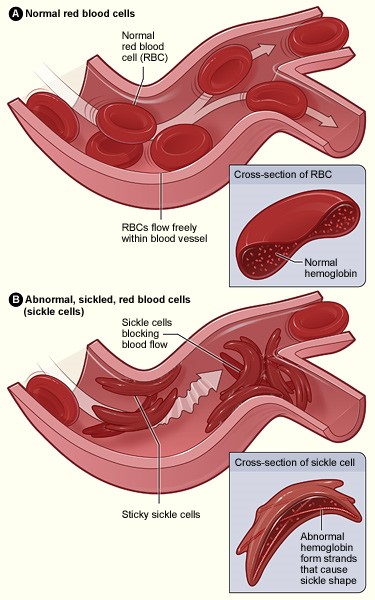
Sickle cell disease is a group of inherited disorders that affect hemoglobin — the major protein that carries oxygen in red blood cells. Normally, red blood cells are disc-shaped and flexible. This allows them to move easily through blood vessels and deliver oxygen to cells and tissues. In sickle cell disease, red blood cells are misshaped, typically crescent- or “sickle”-shaped due to a gene mutation that affects the hemoglobin molecule. When red blood cells sickle, they do not bend or move easily and can block blood flow to the rest of the body.
Sickle cell disease is a lifelong illness that may be managed through preventive screening and treatment strategies. Treatment reduces or helps manage symptoms and increase longevity. With the right care, many people who have sickle cell disease live fulfilling lives and safely participate in most activities.
Related terms: Sickle cell disease is sometimes called sickle cell anemia.
Signs and Symptoms
Symptoms of sickle cell disease vary from person to person and can change over time. Most newborns with sickle cell disease do not have symptoms until they are about 5 or 6 months old.
Early symptoms include:
- Yellowing of the skin (jaundice) or whites of the eyes (icterus)
- Extreme tiredness or fussiness
- Painful swelling of the hands and feet
Other symptoms and complications:
- Attacks of sudden severe pain, called sickle cell crises or pain crises. These can occur without warning and last several hours or several days
- Chronic (long-term) pain, defined as pain lasting longer than three months
- Pain from organ damage affecting the heart, kidneys, spleen, or other body parts
- Joint pain and problems with walking and joint movement
- Priapism, an unwanted and sometimes prolonged painful erection caused when blood flow out of the erect penis is blocked by sickled cells
- Fatigue, shortness of breath, dizziness, and irregular heartbeat
- Fever
- Chest pain, coughing, and difficulty breathing
- Sudden weakness, numbness on one side of the body, confusion, or trouble speaking, seeing, or walking. These are warning signs of stroke
During Pregnancy
Call a healthcare provider or 9-1-1 if you have trouble breathing, extreme swelling of hands or face, thoughts of harming yourself or the baby, or changes in vision. Also seek care right away if a baby’s movements stop or slow, or there is vaginal bleeding or fluid leaking.
Related Health Effects
Sickled cells are destroyed quickly in the body. Normal red blood cells live to 120 days on average, but sickled cells last only 10 to 20 days. The body has trouble keeping up with the cells that are being destroyed. This causes anemia.
Sickle cell disease can cause a range of complications affecting the whole body and specific organs.
Whole-Body Complications
- Pain crisis (also known as a sickle cell or vaso-occlusive crisis): This can happen without warning when sickled red blood cells block blood flow. Common areas affected include the abdomen, chest, lower back, or arms and legs. A pain crisis may be triggered by high altitudes, dehydration, illness, stress, or temperature changes.
- Vitamin deficiency: People with sickle cell disease are at higher risk for nutrient and vitamin deficiencies, such as vitamin D, omega 3, vitamin C, and zinc.
- Delayed growth and puberty: Because of anemia, children with sickle cell disease may grow and develop more slowly than their peers. Full sexual maturity can be delayed.
- Infections: Sickle cell disease can damage the spleen, raising the risk of certain bacterial infections.
- Blood clots: Changes in how blood travels through blood vessels can result in blood clots.
- Pregnancy problems: Sickle cell disease raises the risk of high blood pressure, blood clots, pregnancy loss, preterm birth, and low-birth-weight babies.
Complications Affecting Specific Parts of the Body
- Acute chest syndrome: Sickling in blood vessels of the lungs can damage lung tissue and cause chest pain, fever, and difficulty breathing.
- Enlarged spleen: Red blood cells may get trapped in the spleen, causing them to grow larger than normal and leading to serious anemia.
- Eye problems: Sickle cell disease can injure blood vessels in the eye, most often in the retina (called sickle retinopathy). This can lead to vision loss.
- Gallstones: When red blood cells break down, they release a compound that can form gallstones.
- Heart problems: Complications can include coronary heart disease and pulmonary hypertension.
- Kidney problems: Sickle cell disease may make it difficult for the kidneys to concentrate on urine. Over time, scarring can lead to kidney failure and kidney cancers.
- Leg ulcers: Sores that usually start small and get larger, are slow to heal and may stay as open wounds. Ulcers usually don’t start until after age.
- Liver problems: Sickle cell intrahepatic cholestasis is an uncommon but serious type of liver damage. It is caused by sickled red cells that block blood vessels in the liver.
- Stroke: Sickle cell disease reduces blood flow to the brain, which can cause a stroke, particularly in children.
- Silent brain injury (silent stroke): Damage to the brain without external signs of stroke that can lead to difficulty learning, making decisions, or keeping a job.
Mental Health Effects
Children and adults with sickle cell disease may experience pain, anxiety, and depression.
Effects on Reproduction
- Up to one in four men with sickle cell disease have problems that can affect fertility and sexual function. These include lower than normal sperm count, erectile dysfunction, low levels of testosterone, low sex drive, and fertility problems.
- Women with sickle cell disease may have more pain crises before and during their period.
- Heavy menstrual periods may raise the risk for anemia.
People with sickle cell disease who have high blood pressure are at higher risk for complications, including stroke and kidney disease.
Causes and Risk Factors
Sickle cell disease is most common in people of African, Middle Eastern, Mediterranean, Central and South American, and South Asian origin or descent. Sickle cell disease affects millions of people in the United States and worldwide. In the United States, most people who have sickle cell disease are non-Hispanic Black or African American, but some are also Hispanic or Latino.
People with sickle cell disease inherited two hemoglobin gene variants — one from each parent. Sickle cell disease affects millions of people in the United States and worldwide. These genes make a faulty hemoglobin protein called hemoglobin S. Sickle cell disease can also occur when a child inherits a gene for hemoglobin S (a sickle cell gene) from one parent and a gene for a different type of faulty hemoglobin, such as beta (β) thalassemia or hemoglobin C, from the other parent.
People have sickle cell trait if they inherit a copy of the sickle cell gene from one parent and a copy of the gene for normal hemoglobin, called hemoglobin A, from the other. People who have sickle cell trait make about 60% normal hemoglobin (hemoglobin A) and 40% sickle hemoglobin (hemoglobin S). They may be called carriers because they can pass on the gene for sickle hemoglobin when they have children.
Prevention Guidance
Sickle cell disease is inherited and there are currently no evidence-based prevention measures. However, if you or a loved one is living with sickle cell disease, there are several measures you can take to prevent pain crises, sickle cell crises, and other complications related to sickle cell disease:
- Avoid extreme heat or cold, as well as sudden changes in temperature, are often triggers.
- When going swimming, ease into the water rather than jumping right in.
- Do not travel in an aircraft cabin that is unpressurized.
- Stay up to date on vaccines.
- Wash hands often to help prevent infections.
- Avoid dehydration and vitamin deficiencies.
- Ask your healthcare team about medicines that may control sickle cell disease and help reduce the risk of pain crises.
- Children at risk for stroke should receive regular transcranial ultrasound scans and, if indicated, blood transfusions to lower the chance of a first stroke.
- Early school-age children with sickle cell anemia should have at least one magnetic resonance imaging (MRI) screening, when possible, to look for silent stroke.
Diagnosis
Healthcare providers use several methods to diagnose sickle cell disease:
Blood and Genetic Tests
- Blood tests can detect the hemoglobin S protein and how much.
- Genetic testing can confirm whether a person has one or two copies of the sickle cell gene.
- Similar tests can also look for other abnormal hemoglobin types.
Newborn Screening
- In the United States, babies are screened for many inherited conditions including sickle cell disease and sickle cell trait as part of the newborn screening program at a state newborn screening lab.
- Within the first 24-48 hours after birth, a baby’s heel is pricked, and a few drops of blood are collected onto a special paper card.
- If the screening test is positive, the baby’s doctor will order more tests to find out for sure if the baby has sickle cell trait or sickle cell disease and offer genetic counseling if needed.
Prenatal Screening
- Healthcare providers can diagnose sickle cell disease before a baby is born using a sample of amniotic fluid or a sample taken from the placenta.
- Testing before birth can be done as early as eight to 10 weeks into the pregnancy.
- A technique called pre-implantation genetic diagnosis, used with in vitro fertilization, enables parents to test embryos for the defective gene before implantation.
Treatment and Management
Sickle cell disease is a lifelong illness that can be managed through preventive screening and treatment. Treatment reduces or helps manage symptoms and may help people live longer. There are several ways to manage the disease. These include medicines, blood transfusions, gene therapy, and bone marrow transplants.
Hydroxyurea
Hydroxyurea is an oral medicine that can reduce sickling of red blood cells. It helps prevent serious symptoms, including pain crises. Healthcare providers usually prescribe daily hydroxyurea for infants as young as 9 months old who have sickle cell disease. If it does not manage symptoms enough, your provider can prescribe other medicines as well.
- Use in adults: Hydroxyurea helps reduce serious symptoms such as pain crises and acute chest syndrome. It can also improve anemia and reduce the need for blood transfusions and hospitalizations. It is not yet known whether hydroxyurea can prevent stroke in adults.
- Use in children: Hydroxyurea can help prevent pain crises and hospitalizations for children with sickle cell disease. It lowers the number of pain events and reduces painful swelling of hands and feet. Studies suggest that hydroxyurea does not affect growth in children, but more studies are needed.
- Pregnancy: Women should consult with their healthcare provider before using hydroxyurea if pregnant.
Possible side effects of hydroxyurea include a low white blood cell count or platelet count. Rarely, hydroxyurea can worsen anemia. These side effects usually go away quickly once a patient stops taking the medicine. When the patient restarts it, the healthcare provider usually prescribes a lower dose.
L-glutamine
L-glutamine is approved for preventing acute complications of sickle cell disease in people ages 5 years and older. Taking L-glutamine may lead to fewer hospital admissions, fewer pain crises, less need for blood transfusions, and a lower risk of acute chest syndrome. Side effects may include nausea, fatigue, chest pain, and pain in bones or muscles.
Crizanlizumab-tmca
Crizanlizumab-tmca is approved for adults and children ages 16 years and older who have sickle cell disease. It is given through an intravenous (IV) line once a month and helps prevent blood cells from sticking to blood vessel walls and blocking blood flow.
Antibiotics
Daily treatment with penicillin helps lower children’s chance of having a serious infection in the bloodstream. Many healthcare providers stop prescribing penicillin after a child turns 5 years old.
Blood Transfusions
Red blood cell transfusions raise the number of red blood cells and provide normal red blood cells that are more flexible than sickled cells.
Blood and Bone Marrow Transplant
A blood and bone marrow transplant, also called a hematopoietic stem cell transplant, is a potential curative therapy for some people with sickle cell disease. Transplants require a well-matched donor, usually a close blood relative. Blood and bone marrow transplants are successful in most of children when the donor is a blood relative and a good match. Complications can include graft-versus-host disease, higher risk of some cancers later in life, infertility, seizures, serious infections, and transplant failure.
Gene Therapies
In December 2023, the FDA approved two gene therapies to treat sickle cell disease:
- Exagamglogene autotemcel makes changes to a gene that is already in the body.
- Lovotibeglogene autotemcel adds a modified gene to the body.
Blood and bone marrow transplants and gene therapies require weeks in hospital, specialized care, and costly medicines. Even if a person with sickle cell disease is treated with a blood and bone marrow transplant or gene therapy, they can still pass the sickle cell gene to their children.
Pain Management
Over-the-counter pain medicines, such as acetaminophen or ibuprofen, can treat mild to moderate pain. Prescription pain medicines, including opioids, may be needed for serious pain. Other approaches may help lower pain, especially if it is not well managed with medicines:
- Acupuncture
- Exercise or movement programs, such as yoga
- Massage
Mental Health Support
Supportive counseling and, sometimes, cognitive behavioral therapy, meditation and mindfulness practices and antidepressant medicines may help people with sickle cell disease manage anxiety and depression.
Living With Sickle Cell Disease
With the right care, many people with sickle cell disease live fulfilling lives and safely participate in most activities.
Routine Medical Care
- Most people with sickle cell disease should see their provider every 3 to 12 months, depending on their age and the type of sickle cell disease they have.
- Work closely with your healthcare team to develop a unique care plan.
- Ask your healthcare team to check your blood pressure on each visit and learn how to manage it if it is consistently higher than 130/80 mm Hg.
Managing a Pain Crisis
- Set up a pain action plan with your healthcare provider ahead of time.
- When an acute crisis is just starting, drink lots of fluids and take a nonsteroidal anti-inflammatory drug such as ibuprofen. If you have kidney problems, acetaminophen is often preferred.
- Apply heat to the painful area with a heating pad or compress.
- If you cannot manage the pain at home, go to a clinic or emergency department to receive additional, stronger medicines and IV fluids.
- Keep a copy of your pain management plan when you seek emergency care.
Healthy Lifestyle
- Be physically active.
- Choose heart-healthy foods.
- Drink enough water daily to avoid dehydration.
- Limit alcohol.
- Quit smoking or vaping. For free help and support, visit smokefree.gov or call the National Cancer Institute’s Smoking Quitline at 1-877-44U-QUIT (1-877-448-7848).
- Aim for 7–9 hours of sleep each night.
- Manage stress, as it is an important and common trigger for sickle cell disease complications.
For Caregivers and Families
- If your child attends day care, preschool, or school, talk with their teacher about the disease so they know what symptoms to watch for and how to accommodate your child.
- Caretakers should learn how to feel a child’s spleen daily and more often when the child is ill.
Pregnancy and Reproduction
- Preconception and prenatal care are key to managing risks for the pregnant woman and the developing baby.
- If you are pregnant or planning for pregnancy, find a team of healthcare providers who specialize in high-risk pregnancies and have experience with patients who have sickle cell disease.
- Women taking hydroxyurea should consult with their healthcare provider about use of hydroxyurea if they are planning to become pregnant.
- Discuss birth control options with your provider, as some hormone-based methods might not be safe for women with sickle cell disease.
Find Clinical Trials
Clinical trials uncover better ways to prevent, diagnose, treat, and understand diseases and conditions. To ensure results apply to everyone, volunteers of all ages, sexes, and backgrounds, including both healthy individuals and those with specific medical conditions, are needed. Find clinical trials on sickle cell disease.
Community Support
- Find information about newborn screening labs
- Get the Steps to Better Health Toolkit — Sickle Cell Disease created by the Centers for Disease Control and Prevention in collaboration with the American Society of Hematology, provides fact sheets for people with sickle cell disease.
- Sickle Cell 101
- Sickle Cell Community Consortium
- Sickle Cell Disease Association of America
- Sickle Cell Disease Coalition
- Sickle Cell Disease Foundation
- Sickle Cell Reproductive Health Education Directive
- Sickle Cell Warriors
Note: This resource list is for informational purposes only. It is not comprehensive, and an organization’s inclusion does not constitute an endorsement by NIH.
Research Information
The National Institutes of Health (NIH) is the largest public funder of biomedical research in the world. NIH invests most of its budget in medical research seeking to enhance life and to reduce illness and disability. NIH-funded research has led to breakthroughs and new treatments helping people live longer, healthier lives, and building the research foundation that drives discovery.
Research supported by NIH has helped advance the understanding of sickle cell disease and improved treatment options and clinical care.
Researchers continue to explore optimal cell and gene therapies that may help provide even more improved treatments for sickle cell disease. These include therapies that change a person’s blood-forming stem cells, which could provide an option for people who don’t have a well-matched donor.
Scientists are studying new ways to help more people with sickle cell disease get a transplant, including techniques for children and adults who do not have a matched donor in the family and for people who are older than most recipients.
NIH continues to fund and conduct clinical trials for sickle cell disease.
Find NIH-funded research projects using NIH RePORTER, a searchable database of current and past research projects supported by NIH and other federal agencies.