 An official website of the United States government




Protecting your voice and managing or treating voice problems is important. Voice can impact a person's ability to communicate and for their emotional, social, and often work life.
Emergency Information
You should also see a doctor if you are coughing up blood, have difficulty swallowing, feel a lump in your neck, experience pain when speaking or swallowing, have difficulty breathing, or lose your voice completely for more than a few days.
Vocal fold hemorrhage must be treated immediately with total voice rest and a trip to the doctor.
Overview
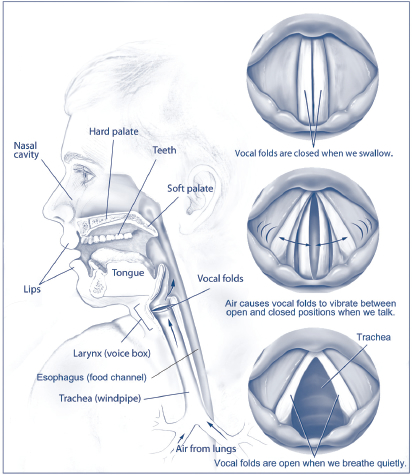
Structures involved in speech and voice production.
Many people have voice problems. Many people also rely on their voices for their work, including singers, teachers, doctors, lawyers, nurses, salespeople, and public speakers. People who use their voice frequently are at a greater risk for developing voice problems. Fortunately, most voice disorders can be successfully treated or avoided.
How Voice Works
The sound of your voice is produced by vibration of the vocal folds. The vocal folds are two bands of smooth muscle tissue that are positioned opposite each other in the larynx. The larynx is located between the base of the tongue and the top of the trachea, which is the passageway to the lungs.
When you are not speaking, the vocal folds are open so that you can breathe. When it's time to speak, however, the brain orchestrates a series of events. The vocal folds snap together while air from the lungs blows past, making them vibrate. The vibrations produce sound waves that travel through the throat, nose, and mouth, which act as resonating cavities to modulate the sound.
The quality of your voice, including its pitch, volume, and tone, is determined by the size and shape of the vocal folds and the resonating cavities. This is why people's voices sound so different.
You can also watch a video to learn more: How Does the Human Body Produce Voice and Speech?
Signs and Symptoms
Hoarseness is a common symptom associated with many issues with your voice. It makes your voice sound breathy, raspy, or strained, or becomes softer in volume or lower in pitch. It is often a symptom of problems in the vocal folds of the larynx. Your throat might also feel scratchy.
You may have a voice problem if you answer "yes" to any of the following questions:
- Has your voice become hoarse or raspy?
- Have you lost your ability to hit some high notes when singing?
- Does your voice suddenly sound deeper?
- Does your throat often feel raw, achy, or strained?
- Has it become an effort to talk?
- Do you find yourself repeatedly clearing your throat?
Related Health Effects
Voice disorders affect more than just communication. Voice, speech, and language disorders often affect a person's emotional and social life. They can also compromise educational and job opportunities.
Causes and Risk Factors
- Causes of voice problems include:
- Upper respiratory infections
- Inflammation caused by gastroesophageal reflux (also called acid reflux, heartburn, or GERD)
- Vocal misuse and overuse
- Cancer of the larynx
- Psychological trauma or mental health condition
- Environmental toxin exposure
- Voice overuse, often due to work demands. Singers, teachers, doctors, lawyers, nurses, salespeople, and public speakers are among those who are at risk for developing voice problems
Voice problems can be caused by growths on the vocal folds:
- Vocal nodules, polyps, and cysts are benign (noncancerous) growths within or along the vocal folds that form as the result of too much pressure or friction. Vocal nodules are sometimes called "singer's nodes" because they are a frequent problem among professional singers. A vocal polyp typically occurs on only one side of the vocal fold, while a vocal cyst is a hard mass of tissue encased in a membrane sac inside the vocal fold.
- Laryngeal papillomatosis (related to recurrent respiratory papillomatosis) is caused by certain strains of human papilloma virus. It can cause non-cancerous growths on the vocal folds. Hoarseness is the most common symptom. Eventually, the tumors may block the airway passage and cause difficulty breathing.
Voice disorders may also be caused by neurological disorders:
- Vocal fold paralysis causes hoarseness and difficulties with breathing such as shortness of breath or noisy breathing, and swallowing problems such as choking or coughing when eating. Changes in voice quality, such as loss of volume or pitch, may also occur.
- Vocal fold paralysis can cause serious health problems beyond voice changes. If the paralyzed fold or folds remain open, the air passages and lungs may be unprotected. Food or liquids could accidentally enter the trachea and lungs. Paralysis of both vocal folds, although rare, can be life threatening.
- Laryngeal dystonia (also known as spasmodic dysphonia) causes voice breaks during speaking and can make the voice sound tight, strained, or breathy. In more severe cases, spasms may occur on every word, making speech very difficult to understand. Some people with laryngeal dystonia may also have vocal tremor — a shaking of the larynx and vocal folds that causes the voice to tremble.
Prevention Guidance
Maintain a Healthy Lifestyle and Diet
- Stay Hydrated. Drink plenty of water, especially when exercising.
- If you drink caffeinated beverages or alcohol, balance your intake with plenty of water.
- Use a humidifier in your home, especially in winter or in dry climates; 30% humidity is recommended.
- Avoid or limit medicines that may dry out the vocal folds, including some common cold and allergy medicines; ask your doctor which medicines are safest for you.
- Don't smoke and avoid secondhand smoke, as smoke irritates the vocal folds, and cancer of the vocal folds is seen most often in people who smoke.
- Include plenty of whole grains, fruits, and vegetables in your diet; these foods contain vitamins A, E, and C and help keep the mucus membranes that line the throat healthy.
- Wash your hands often to prevent getting a cold or the flu.
- Get enough rest. Physical fatigue has a negative effect on voice.
- Exercise regularly to increase stamina and muscle tone, which support good posture and breathing.
- If you have persistent heartburn or gastroesophageal reflux disease (GERD), talk to your doctor about diet changes or medicines that can help reduce flare-ups.
- Avoid mouthwash or gargles that contain alcohol or irritating chemicals.
Use Your Voice Wisely
- Take vocal naps. Rest your voice periodically throughout the day.
- Try not to overuse your voice. Avoid speaking or singing when your voice is hoarse or tired.
- Rest your voice when you are sick, as illness puts extra stress on your voice.
- Avoid using the extremes of your vocal range, such as screaming or whispering, both talking too loudly and too softly can stress your voice.
- Practice good breathing techniques when singing or talking; support your voice with deep breaths from the chest rather than relying on your throat alone.
- Consider using a microphone in relatively static environments such as classrooms or exercise rooms.
- Avoid talking in noisy places, as trying to talk above noise causes strain on the voice.
Vaccination
Vaccination with the human papilloma virus (HPV) vaccine could prevent the development of laryngeal papillomatosis. The Centers for Disease Control and Prevention (CDC) currently recommends that all children, both boys and girls, receive the HPV vaccine at age 11 or 12.
Diagnosis
If you think you have a voice problem, consult a doctor to determine the underlying cause. A doctor who specializes in diseases or disorders of the ears, nose, and throat, called an otolaryngologist, sometimes called an ear, nose, and throat doctor or ENT, can best diagnose a voice disorder.
Your doctor will ask about your health history and how long you have been hoarse. They may also assess your voice loudness, pitch, and voice quality.
Other assessments may be performed, depending on your symptoms and symptom severity, such as:
- Laryngeal electromyography, which measures the electrical impulses of the nerves in the larynx
- Fiberoptic nasolaryngoscopy, where a small lighted tube through the nose and into the back of the throat to evaluate vocal fold anatomy and movements
- Assessment of voice symptoms by a speech-language pathologist
- Assessment by a neurologist, who can assess if your voice is affected by movement disorders based in the brain
Treatment and Management
Most voice problems can be reversed by treating the underlying cause. They also may require a range of behavioral and surgical treatments. See your doctor if your voice has been hoarse for more than three weeks, especially if you haven't had a cold or the flu.
Laryngitis
Your doctor will treat laryngitis according to its cause. If it is due to a cold or upper respiratory infection, your doctor might recommend rest, fluids, and nonprescription pain relievers. Allergies might be treated similarly, with the addition of over-the-counter allergy medicines.
Voice Misuse or Overuse
Resting, reducing voice use, and drinking lots of water should help relieve hoarseness from misuse or overuse. If you use your voice for a living and regularly experience hoarseness, your doctor might suggest seeing a speech-language pathologist for voice therapy. In voice therapy, you receive vocal exercises and tips for avoiding hoarseness by changing the ways you use your voice.
Acid Reflux Disorders
These conditions are treated with dietary modifications and medicines that reduce stomach acid.
Vocal Nodules, Polyps, and Cysts
The most common treatments are voice rest, voice therapy, and surgery to remove the tissue.
Vocal Fold Hemorrhage
If you lose your voice suddenly during strenuous vocal use (such as yelling), you may have a vocal fold hemorrhage. Vocal fold hemorrhage occurs when a blood vessel on the surface of the vocal fold ruptures and the tissues fill with blood. Sometimes a vocal fold hemorrhage will cause hoarseness to develop quickly over a short amount of time and only affect your singing but not your speaking voice. Vocal fold hemorrhage must be treated immediately with total voice rest and a trip to the doctor.
Vocal Fold Paralysis
The most common treatments are voice therapy and surgery. Some people's voices naturally recover sometime during the first year after diagnosis, which is why doctors often delay surgery for at least a year. Voice therapy may involve exercises to strengthen the vocal folds or improve breath control while speaking. Several surgical procedures are available, depending on whether one or both vocal folds are paralyzed; the most common procedures change the position of the vocal fold. When both vocal folds are paralyzed, a tracheotomy may be required to help breathing.
Laryngeal Dystonia, Also called Spasmodic Dysphonia
There is currently no cure for laryngeal dystonia, but treatment can help reduce its symptoms. The most common treatment is the injection of very small amounts of botulinum toxin directly into the affected muscles of the larynx. Botulinum toxin injections generally improve the voice for three to four months, after which voice symptoms slowly return, and reinjections are needed to maintain a good speaking voice. Behavioral therapy (voice therapy) may reduce symptoms in mild cases. When more conventional measures have failed, surgery may be performed on the larynx.
Recurrent Respiratory Papillomatosis
There is no cure for this disorder, but surgery is the primary method for removing tumors from the larynx or airway. Many surgeons now use laser surgery to avoid scarring of the larynx tissue. It is common for patients to require multiple surgeries, as tumors can still return after removal. In severe cases, drug treatments may include antivirals.
Living With Chronic Voice Disorders
A speech-language pathologist can help you improve the way you use your voice and avoid vocal overuse.
Teachers and others who rely heavily on their voices may benefit from using a lightweight microphone and an amplifier-speaker system to reduce vocal strain.
People with laryngeal dystonia may benefit from psychological counseling to help them accept and live with their voice problems. Augmentative and assistive devices can also help some people with laryngeal dystonia communicate more easily. Some devices amplify a person's voice, whether in person or over the phone, while computer software and smartphone or tablet apps can translate text into synthetic speech.
In severe cases of recurrent respiratory papillomatosis, patients who require a tracheotomy can learn to use their voice with the help of a voice specialist or speech-language pathologist who specializes in voice.
Support and encouragement from family members and friends, along with extra practice in the home environment, are important for people working through voice and speech challenges.
Find Clinical Trials
Clinical trials uncover better ways to prevent, diagnose, treat, and understand diseases and conditions. To ensure results apply to everyone, volunteers of all ages, sexes, and backgrounds, including both healthy individuals and those with specific medical conditions, are needed. Find clinical trials on voice disorders.
Find Treatment
If you think you have a voice problem, consult an otolaryngologist — the physician and surgeon who specializes in ear, nose, and throat disorders — to determine the underlying cause. Your otolaryngologist may refer you to a speech-language pathologist, who can help you improve the way you use your voice.
Community Support
- Dysphonia International
- Recurrent Respiratory Papillomatosis Foundation
- Voice Foundation
- The Voice Academy
- Voice Health Institute
Note: This resource list is for informational purposes only. It is not comprehensive, and an organization’s inclusion does not constitute an endorsement by NIH.
Research Information
The National Institutes of Health (NIH) is the largest public funder of biomedical research in the world. NIH invests most of its budget in medical research seeking to enhance life and to reduce illness and disability. NIH-funded research has led to breakthroughs and new treatments helping people live longer, healthier lives, and building the research foundation that drives discovery.
NIH supports research that includes laboratory studies to understand diseases and stresses that can harm the voice, and clinical research to test new ways to diagnose, treat, or cure voice disorders.
Researchers are exploring how the brain controls the muscles and nerves of the larynx and tongue, and how these structures move to produce speech. This information may help scientists design better treatments for conditions such as vocal fold paralysis and laryngeal dystonia. Researchers are also developing replacement tissues to repair damaged vocal folds, testing man-made and biological materials and stem cell technologies that may eventually be used to engineer new vocal fold tissues.
Find NIH-funded research projects using NIH RePORTER, a searchable database of current and past research projects supported by NIH and other federal agencies.