 An official website of the United States government




Common disorders that affect the thyroid gland include hypothyroidism, hyperthyroidism, thyroid nodules, and thyroid cancer.
Emergency Information
While taking thyroid hormone medication, call your doctor or visit the emergency room if you develop a sense of your heart fluttering or detect a rapid heart rate. These can be indications that you are taking too much thyroid hormone and it is affecting the rhythm of your heartbeat.
While taking drugs for hyperthyroidism, call your doctor right away if you have any of the following symptoms:
- Fatigue or weakness
- Dull pain in your abdomen
- Loss of appetite
- Skin rash, itching, or easy bruising
- Yellowing of your skin or the whites of your eyes, called jaundice
- Fever, chills, or constant sore throat
If you are taking antithyroid medicines during pregnancy and develop yellowing of your skin or eyes, dull pain in your abdomen, a constant sore throat, or fever, stop your medicine and call your doctor right away. If you do not hear back from your doctor the same day, go to the nearest emergency room.
Overview
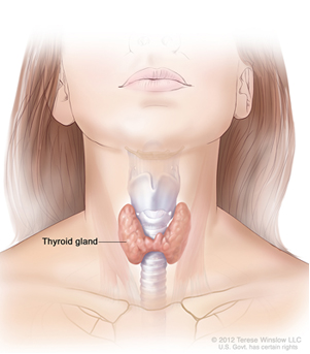
The thyroid is a small, butterfly-shaped gland in the front of your neck. The thyroid makes two hormones, thyroxine (T4) and triiodothyronine (T3), that control how the body uses energy. The thyroid generates hormones that affect nearly every organ in your body, even the way your heart beats.
Sometimes the thyroid makes too much or too little of these hormones, leading to conditions that can affect your overall health. Thyroid disease is a group of disorders that affect the thyroid gland including hypothyroidism, hyperthyroidism, thyroid nodules, and thyroid cancer.
Both hypothyroidism and hyperthyroidism are more common in women and in people older than age 60. However, these disorders can occur at any age and in both sexes.
In addition, there are four main types of thyroid cancer. Learn more about these different types of cancer at Thyroid Cancer.
Signs and Symptoms
Hypothyroidism
Hypothyroidism occurs when the thyroid gland does not make enough thyroid hormones to meet your body’s needs. Without enough thyroid hormones, many of your body’s functions slow down. Many of these cases are initially mild or have few obvious symptoms, a condition often referred to as subclinical hypothyroidism.
Common symptoms of hypothyroidism include:
- Fatigue
- Weight gain
- Trouble tolerating cold
- Joint and muscle pain
- Dry skin or dry, thinning hair
- Heavy or irregular menstrual periods or fertility problems
- Slowed heart rate
- Depression
- Constipation
Because hypothyroidism develops slowly, you may not notice symptoms for months or even years. Many of these symptoms, especially fatigue and weight gain, are common and do not necessarily mean you have a thyroid problem.
Untreated hypothyroidism can also lead to:
- High cholesterol
- Heart disease and heart failure
- High blood pressure
- Myxedema, a rare condition in which the body’s functions slow down to the point that it can threaten your life
Hashimoto’s disease
Hashimoto’s disease is an autoimmune disorder that is the most common cause of hypothyroidism. In people with Hashimoto’s disease, the immune system attacks the thyroid gland. Large numbers of white blood cells build up in the thyroid, and the thyroid becomes damaged and cannot make enough thyroid hormones.
Many people with Hashimoto’s disease have no symptoms at first. As the disease progresses, you may have one or more symptoms of hypothyroidism.
Hashimoto’s disease can cause your thyroid your thyroid to larger and cause the front of the neck to look swollen. The enlarged thyroid, called a goiter, may create a feeling of fullness in your throat, though it is usually not painful. After many years, or even decades, damage to the thyroid may cause the gland to shrink and the goiter to disappear.
Hyperthyroidism
Hyperthyroidism occurs when the thyroid gland makes more thyroid hormones than your body needs. With too much thyroid hormone, many of your body’s functions speed up.
Symptoms of hyperthyroidism can vary from person to person and may include:
- Weight loss despite an increased appetite
- Rapid or irregular heartbeat
- Nervousness, irritability, trouble sleeping, and fatigue
- Shaky hands and muscle weakness
- Sweating or trouble tolerating heat
- Frequent bowel movements
- An enlargement in the neck, called a goiter
In older adults, hyperthyroidism is sometimes mistaken for depression or dementia. Older adults may have different symptoms — such as loss of appetite or withdrawal from people — than younger adults with hyperthyroidism.
Untreated hyperthyroidism can cause serious health problems, including:
- An irregular heartbeat that can lead to blood clots, stroke, heart failure, and other heart-related problems
- Thinning bones, osteoporosis, and muscle problems
- Menstrual cycle and fertility issues
- Severe weight loss and wasting
- A severe, life-threatening form of hyperthyroidism, known as thyroid storm
Graves’ disease
Graves’ disease is an autoimmune disorder that is the most common cause of hyperthyroidism. With Graves’ disease, the immune system attacks the thyroid gland, causing it to make more thyroid hormones than the body needs.
Some people with Graves’ disease develop an eye disease called Graves’ ophthalmopathy, or thyroid eye disease (TED). TED occurs when the immune system attacks the muscles and other tissues around the eyes. Symptoms can include:
- Bulging eyes
- Gritty, irritated eyes
- Puffy eyes
- Light sensitivity
- Pressure or pain in the eyes
- Blurred or double vision
Rarely, people with Graves’ disease develop a condition that causes the skin to become reddish and thick, with a rough texture, called Graves’ dermopathy or pretibial myxedema. This condition usually affects the shins but can also develop on the top of the feet and other parts of the body.
Thyroid Disease During Pregnancy
Both hypothyroidism and hyperthyroidism can occur before and immediately following pregnancy. Hyperthyroidism that occurs during pregnancy is usually due to Graves’ disease. Hypothyroidism that is first diagnosed during pregnancy is generally due to mild Hashimoto’s disease that has become worse during pregnancy due to the increased demands on the mother’s thyroid associated with pregnancy. A common type of thyroid dysfunction after pregnancy is known as postpartum thyroiditis. The classic example of postpartum thyroiditis is an initial period of inflammation and thyroid damage leading to high levels of leaked thyroid hormone for several weeks, followed by low levels of thyroid hormone for several weeks due to the temporary effects of the thyroid damage. Finally, a return to normal thyroid hormone levels occurs as the thyroid fully recovers. Some women only experience the hypothyroid phase and some women never fully return to normal thyroid levels and need to start thyroid hormone replacement therapy.
Some signs and symptoms of normal pregnancy can be confused with hyperthyroidism, including faster heart rate, trouble dealing with heat, and tiredness. More specific signs that suggest hyperthyroidism during pregnancy include goiter (thyroid enlargement), fast and irregular heartbeat, shaky hands, and frequent bowel movements, and unexplained weight loss or failure to have normal pregnancy weight gain.
Symptoms of hypothyroidism during pregnancy include extreme tiredness, trouble dealing with cold, muscle cramps, severe constipation, and problems with memory or concentration.
Symptoms of postpartum thyroiditis during the hypothyroid phase may be mistaken for the effects of sleep deprivation and mood changes that sometimes accompany normal childbirth. Symptoms may also include trouble dealing with cold, dry skin, trouble concentrating, and tingling in the hands, arms, feet, or legs.
Untreated hyperthyroidism during pregnancy can lead to
- Miscarriage
- Premature birth
- Low birthweight
- Preeclampsia
- Thyroid storm
- Congestive heart failure
Because thyroid hormones are so important to your baby’s brain and nervous system development, untreated hypothyroidism, especially during the first trimester, can cause low IQ and problems with normal development.
Diagnosis
Doctors cannot diagnose hypothyroidism or hyperthyroidism based on symptoms alone because many symptoms are the same as those of other diseases. Doctors use several blood tests and sometimes imaging tests to confirm a diagnosis and find its cause.
Blood Tests
Healthcare professionals use the following blood tests to check thyroid function, such as:
- TSH test: A high TSH level most often means you have hypothyroidism; a low TSH level usually means you have hyperthyroidism.
- T4 tests: A high blood level of T4 may mean you have hyperthyroidism; a low level of T4 may mean you have hypothyroidism. Many healthcare professionals prefer to measure free T4 because changes in binding protein levels do not affect free T4 levels.
- T3 test: Sometimes T4 is normal yet T3 is high, so measuring both T4 and T3 levels can be useful in diagnosing hyperthyroidism.
- Thyroid antibody tests: Measuring levels of thyroid antibodies may help diagnose an autoimmune thyroid disorder such as Graves’ disease or Hashimoto’s disease.
Imaging Tests
- Ultrasound: Most often used to look for thyroid nodules — lumps in the neck — and to help determine if nodules are more likely to be cancerous. The ultrasound usually takes around 30 minutes.
- Thyroid scan: Used to look at the size, shape, and position of the thyroid gland and to help find the cause of hyperthyroidism. You should not have this test if you are pregnant or breastfeeding. Many endocrinologists now rely on antibody testing rather than imaging to diagnose Graves’ disease.
- Radioactive iodine uptake test: Also called a thyroid uptake test, this test can help check thyroid function and find the cause of hyperthyroidism. You should not have this test if you are pregnant or breastfeeding.
- Doppler ultrasound: Uses sound waves to detect increased blood flow in the thyroid due to Graves’ disease; may be ordered if radioactive iodine uptake is not a good option, such as during pregnancy or breastfeeding.
Fine Needle Aspiration Biopsy
If a thyroid nodule is found in the neck, a fine needle aspiration biopsy may be performed to see if the lump is cancerous. An endocrinologist or specially trained radiologist places a needle through the skin and uses ultrasound to guide the needle to the nodule. This procedure usually takes less than 30 minutes.
Diagnosing Thyroid Disease During Pregnancy
Thyroid problems can be hard to diagnose in pregnancy due to higher levels of thyroid hormones and other symptoms that occur in both pregnancy and thyroid disorders. Two pregnancy-related hormones — human chorionic gonadotropin (hCG) and estrogen — cause higher measured thyroid hormone levels in the blood. In the case of estrogen, the binding proteins for thyroid hormone are increased but the free thyroid hormone levels are not affected.
Treatment and Management
Treating Hypothyroidism
Hypothyroidism is treated by replacing the hormones that the thyroid can no longer make. The medicine levothyroxine (a thyroid hormone medicine identical to a hormone a healthy thyroid makes) is the recommended treatment. Usually prescribed in pill form, this medicine is also available as a liquid and as a soft gel capsule.
Some foods and supplements can affect how well the body absorbs levothyroxine, including grapefruit juice, espresso coffee, soy, and multivitamins that contain iron or calcium. Taking the medicine on an empty stomach can prevent this from happening.
Your doctor will give you a blood test about 6 to 8 weeks after you begin taking the medicine, adjusting your dose if needed. Once you reach a dose that works for you, your doctor will likely repeat the blood test in 6 months and then once a year.
Never stop taking your medicine without talking with your doctor first. Taking too much thyroid hormone medicine can cause serious problems, such as atrial fibrillation or osteoporosis.
If you have been diagnosed as having Hashimoto’s thyroiditis but your thyroid hormone levels are still normal, your doctor will follow your symptoms and regular blood tests regularly to make sure your levels remain normal.
Treating Hyperthyroidism
Hyperthyroidism is usually treated with medicines, radioiodine therapy, or thyroid surgery. No single treatment works for everyone, and your treatment depends on what is causing your hyperthyroidism and how severe it is.
Beta-blockers can reduce symptoms — such as tremors, rapid heartbeat, and nervousness — until other treatments start working, and can make you feel better within hours. However, they do not stop thyroid hormone production.
Antithyroid medicines cause the thyroid to make less thyroid hormone. Methimazole is used most often. Propylthiouracil is often used for women during the first 3 months of pregnancy because methimazole can, on rare occasions, harm the fetus. Antithyroid medicines can cause side effects, including allergic reactions, a decrease in white blood cells, and, in rare cases, liver inflammation or failure. Treatment takes about 1–2 years on average but can continue in lower doses for many years in some patients.
Radioiodine therapy destroys the cells of the thyroid gland that produce thyroid hormone and does not affect other body tissues. Almost everyone who gets radioiodine therapy later develops hypothyroidism, but hypothyroidism is easier to treat and causes fewer long-term health problems. Radioiodine therapy is not used for women who are pregnant or breastfeeding. Many patients and doctors in the United States and elsewhere have shifted preferred management of Graves’ disease away from radioiodine and are more likely to treat with antithyroid drugs.
Thyroid surgery to remove part or most of the thyroid gland is used less often. When part of the thyroid is removed, thyroid hormone levels may return to normal, but you may develop hypothyroidism after surgery and need to take thyroid hormone medicine. If the whole thyroid is removed, you will need to take thyroid hormone medicine for life.
Researchers are also looking into a new approach called radiofrequency ablation (RFA) for treating thyroid nodules that cause hyperthyroidism, used mainly in cases where medicines or surgery will not help.
Treating Thyroid Eye Disease (TED)
Most cases of TED are mild. Tips to control mild symptoms include:
- Eye drops to relieve dry, gritty, irritated eyes
- Taping eyelids shut at night or wearing an eye mask if eyelids do not fully close
- Sleeping with your head raised to reduce puffy eyelids
- Sunglasses to help with light sensitivity
- Special eyeglass lenses to reduce double vision
If you have severe TED, your doctor may recommend steroids or other medicines that reduce the body’s immune response, surgery to improve bulging eyes or correct changes to vision, or, very rarely, radiation therapy to the muscles and tissues around the eyes.
Treating Thyroid Disease During Pregnancy
If you have mild hyperthyroidism during pregnancy, you probably will not need treatment. If your hyperthyroidism is more severe, your doctor may prescribe antithyroid medicines. Doctors most often treat pregnant women with propylthiouracil (PTU) during the first 3 months of pregnancy. Radioactive iodine treatment is not an option for pregnant women because it can damage the baby’s thyroid gland.
For hypothyroidism during pregnancy, your doctor will likely prescribe levothyroxine, which is safe for your baby. If you had hypothyroidism before becoming pregnant and are taking levothyroxine, you will probably need to increase your dose. Most thyroid specialists recommend taking two extra doses of thyroid medicine per week, starting right away.
Your doctor will most likely test your thyroid hormone levels every 4 to 6 weeks for the first half of your pregnancy, and at least once after 30 weeks.
Living With Thyroid Disease
Diet and Iodine
Your thyroid uses iodine to make thyroid hormones. If you have Hashimoto’s disease or Graves’ disease, you may be sensitive to harmful side effects from iodine. Eating foods with large amounts of iodine, such as kelp, dulse, or other kinds of seaweed — may cause or worsen thyroid problems. Taking iodine supplements can have the same effect.
Talk with members of your healthcare team about:
- What foods to limit or avoid
- Whether you take iodine supplements
- Any cough syrup or multivitamins you take, because they may contain iodine
If you are pregnant, you need more iodine because the baby gets iodine from your diet. During pregnancy, you need about 250 micrograms of iodine a day.
Smoking and Thyroid Eye Disease
If you smoke or use other tobacco products, stop. You can start by calling the National Quitline at 1-800-QUITNOW or 1-800-784-8669. For tips on quitting, you can go to Smokefree.gov.
Find Clinical Trials
Clinical trials uncover better ways to prevent, diagnose, treat, and understand diseases and conditions. To ensure results apply to everyone, volunteers of all ages, sexes, and backgrounds, including both healthy individuals and those with specific medical conditions, are needed. Find clinical trials on thyroid disease.
Research Information
The National Institutes of Health (NIH) is the largest public funder of biomedical research in the world. NIH invests most of its budget in medical research seeking to enhance life and to reduce illness and disability. NIH-funded research has led to breakthroughs and new treatments helping people live longer, healthier lives, and building the research foundation that drives discovery.
NIH conducts and supports clinical trials in many diseases and conditions, including endocrine diseases. These trials look to find new ways to prevent, detect, or treat disease and improve quality of life.
Researchers are studying many aspects of hypothyroidism, such as understanding how the disease progresses, its clinical presentation, and genetics, as well as investigating how effective and safe levothyroxine is for people with chronic kidney disease.
Some scientists are studying various aspects of hyperthyroidism, such as its natural history, clinical presentation, and genetics. Researchers are also looking into new ways to treat hyperthyroidism. These include new immune therapies that interfere with the antibodies that cause Graves’ disease. They also include radiofrequency ablation (RFA), a new approach to treating thyroid nodules that cause hyperthyroidism.
Find NIH-funded research projects using NIH RePORTER, a searchable database of current and past research projects supported by NIH and other federal agencies.