 An official website of the United States government




Otitis media is inflammation or infection of the middle ear that can cause fluid to build up behind the eardrum.
Overview
Otitis media—often referred to as a (middle) ear infection—is an inflammation of the middle ear, usually caused by bacteria, that can cause fluid to build up behind the eardrum. Anyone can get an ear infection, but children get them more often than adults. Most children will have at least one ear infection by their third birthday. Ear infections are the most common reason parents bring their child to a doctor.
How the Ear Works
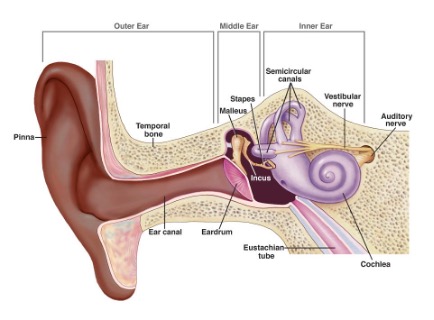
Source: NIH/National Institute on Deafness and Other Communication Disorders (NIDCD)
The ear has three major parts — the outer ear, the middle ear, and the inner ear. The middle ear is where otitis media, the most common ear infection, occurs. Within the middle ear are three tiny bones — the malleus, incus, and stapes — that transmit sound vibrations from the eardrum to the inner ear. The eustachian tube connects the upper part of the throat to the middle ear, supplying fresh air, draining fluid, and keeping air pressure steady. Adenoids are small pads of tissue near the eustachian tubes that fight off infection by trapping bacteria that enter through the mouth. See the Healthy Hearing page for more information.
Signs and Symptoms
There are three main types of middle ear infections, each with a different combination of symptoms.
- Acute otitis media is the most common. The middle ear becomes infected and inflamed, and fluid gets trapped behind the eardrum, causing an earache and possibly a fever.
- Otitis media with effusion can happen after an ear infection has run its course and fluid stays trapped behind the eardrum. Otitis media with effusion may have no symptoms.
- Chronic otitis media with effusion happens when fluid remains in the middle ear for a long time or returns over and over again, even though there is no infection.
Most ear infections happen to children before they have learned to talk. If your child is not old enough to say “My ear hurts,” look for these signs:
- Tugging or pulling at the ear(s)
- Fussiness and crying
- Trouble sleeping
- Fever, especially in infants and younger children
- Fluid draining from the ear
- Clumsiness or problems with balance
- Trouble hearing or responding to quiet sounds
Children with otitis media with effusion may have no symptoms, but a doctor can see fluid behind the eardrum with a special instrument.
Once an infection clears, fluid may remain in the middle ear but usually disappears within 3–6 weeks.
Causes and Risk Factors
An ear infection often follows a sore throat, cold, or other upper respiratory infection. If the upper respiratory infection is bacterial, the bacteria may spread to the middle ear. If the infection is viral, bacteria may move into the middle ear as a secondary infection. The infection causes fluid to build up behind the eardrum.
Children get ear infections more often than adults for several reasons:
- Smaller eustachian tubes: Children’s eustachian tubes are smaller and more horizontal than adults’, making it harder for fluid to drain — especially when swollen or blocked by mucus from a cold.
- Developing immune systems: A child’s immune system is still developing, making it harder to fight infections.
Prevention Guidance
The best way to prevent ear infections in children is to reduce the risk factors associated with them. Steps you can take include:
- Get a flu vaccine every year.
- Wash hands frequently. This prevents the spread of germs.
Some additional methods may help prevent ear infections in children:
- Get the pneumococcal conjugate vaccine (PCV13). The Centers for Disease Control and Prevention (CDC) recommends that children under age 2 be vaccinated, starting at 2 months of age. Studies show that vaccinated children get far fewer ear infections than unvaccinated children. The vaccine is strongly recommended for children in daycare.
- Avoid exposing your baby to cigarette smoke. Studies show that babies around smokers have more ear infections.
- Do not put your baby to bed with a bottle.
- Limit your child’s exposure to sick children as much as possible.
Diagnosis
A doctor will first ask about health history — such as a recent head cold or sore throat, trouble sleeping, or in the case of a child, if they have been pulling at the ears.
Doctors use several tools to diagnose ear infections:
- Otoscope: A lighted instrument used to look at the eardrum. A red, bulging eardrum indicates an infection.
- Pneumatic otoscope: Blows a puff of air into the ear canal to check for fluid behind the eardrum. A normal eardrum moves back and forth more easily than one with fluid behind it.
- Tympanometry: Uses sound tones and air pressure to measure how flexible the eardrum is at different pressures.
Treatment and Management
Many doctors prescribe an antibiotic, such as amoxicillin, to be taken over 7–10 days to treat an ear infection. Doctors may also recommend over-the-counter pain relievers such as acetaminophen or ibuprofen, or eardrops, to help with fever and pain. Aspirin should not be given to a child who has a fever or flu-like symptoms unless instructed by a doctor, because aspirin is considered a major preventable risk factor for Reye’s syndrome.
If a doctor cannot make a definite diagnosis and there is no severe ear pain or a fever, the doctor might ask you to wait 1–2 days to see if the earache goes away. The American Academy of Pediatrics issued guidelines in 2013 that encourage doctors to observe and closely follow children with ear infections that cannot be definitively diagnosed, especially those between the ages of 6 months and 2 years. If there is no improvement within 2 to 3 days from when symptoms began, the guidelines recommend starting antibiotic therapy.
If your doctor prescribes an antibiotic, make sure they are taken as instructed and for the full amount of time — even if symptoms improve in a few days. Stopping the medicine too soon could allow the infection to come back. If sickness persists after several days, call your doctor, as a different antibiotic may be needed.
Recurring Ear Infections
To keep a middle ear infection from coming back, limit risk factors (see Prevention section above).
Some children may still have as many as five or six ear infections per year despite these precautions. Your doctor may wait several months to see if things improve on their own before recommending surgery. For children with recurring infections, a doctor may recommend:
- Ventilation tubes (or, pressure equalization, PE, tubes): A surgical procedure that places a small tube in the eardrum to improve air flow and prevent fluid backup. The most commonly used tubes stay in place for 6–9 months and require follow-up visits until they fall out.
- Adenoid removal: If tube placement still does not prevent infections, a doctor may consider removing the adenoids to prevent infection from spreading to the eustachian tubes. Adenoids are tissue located behind your nasal passage that help trap germs that enter your body through your nose and mouth.
Chronic or recurrent otitis media makes it harder for children to fight new infections and can impact their hearing. Hearing loss can lead to delays in speech and language development.
Find Clinical Trials
Clinical trials uncover better ways to prevent, diagnose, treat, and understand diseases and conditions. To ensure results apply to everyone, volunteers of all ages, sexes, and backgrounds, including both healthy individuals and those with specific medical conditions, are needed. Find clinical trials on ear infections in children.
Research Information
The National Institutes of Health (NIH) is the largest public funder of biomedical research in the world. NIH invests most of its budget in medical research seeking to enhance life and to reduce illness and disability. NIH-funded research has led to breakthroughs and new treatments helping people live longer, healthier lives, and building the research foundation that drives discovery.
NIH-funded researchers are working to improve the prevention, diagnosis, and treatment of middle ear infections. Key areas of research include:
- Finding better ways to predict which children are at higher risk of developing an ear infection
- Understanding why some children — including Native American and Hispanic children — have more ear infections than others
- Studying colonies of antibiotic-resistant bacteria called biofilms, found in the middle ears of most children with chronic ear infections, to find ways to attack and kill them
- Creating more accurate methods to diagnose middle ear infections
- Evaluating current drugs and developing new, more effective ways to administer medicines
- Studying the impact that chronic/recurring ear infections have on a child’s speech and language development
Find NIH-funded research projects using NIH RePORTER, a searchable database of current and past research projects supported by NIH and other federal agencies.